

Overview
Each token tracked on Tokenomist has a dedicated page that consolidates release schedules, allocations, and methodology in one place. This shows you not only when tokens are released, but also who benefits and how precise the data is. By combining every aspect of supply analysis into one standardized view, the Token Page makes it easier to evaluate dilution risk, investor incentives, and long-term sustainability at a glance.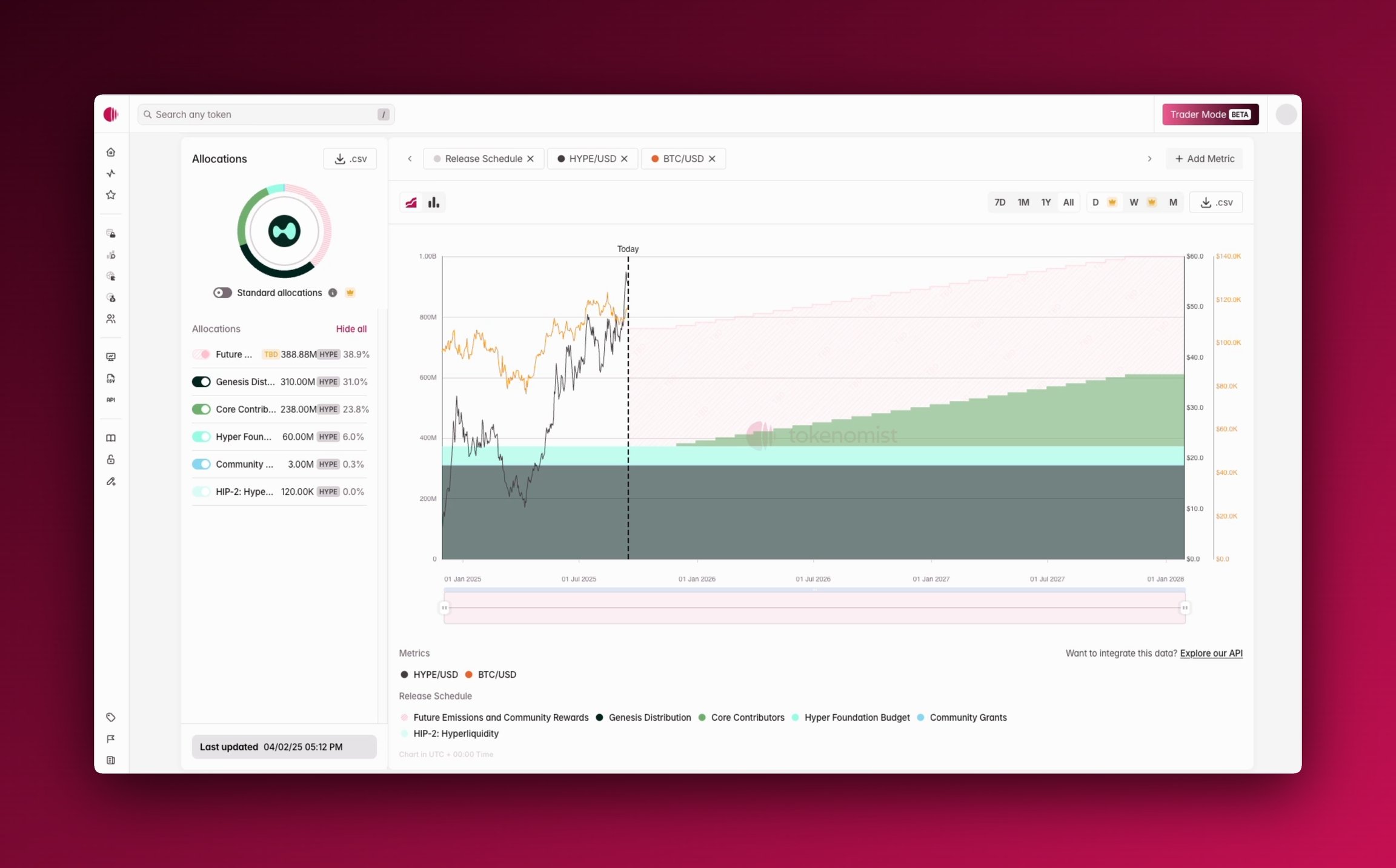
Access
The Token Page is available for every tracked asset in Tokenomist. You can access it by searching directly from the sidebar or top navigation, or by clicking into any token from features such as the overview, token unlocks, emission screener, allocation screener, on-chain claims, fundraising, buyback screener, or burn screener.Tabs on a token page appear conditionally based on available data. Not every token will show all tabs (e.g., Burn, Buyback, Fundraising, or Claimed may not appear if no data exists for that token). Recently added tabs may display a (NEW) badge.
- Emission: Net supply changes (cliff, linear, inflation, deflation). See Precision and Assumption for how we categorize releases into cliff unlocks or linear releases.
- Unlock Progress & Notable Events: A snapshot of total released supply and upcoming cliff unlocks.
- Release Schedule: An interactive token release chart with allocation toggles and metric overlays.
- Tokenomics Reference: Source reliability via Precision and Assumption.
Features
Highlight bar
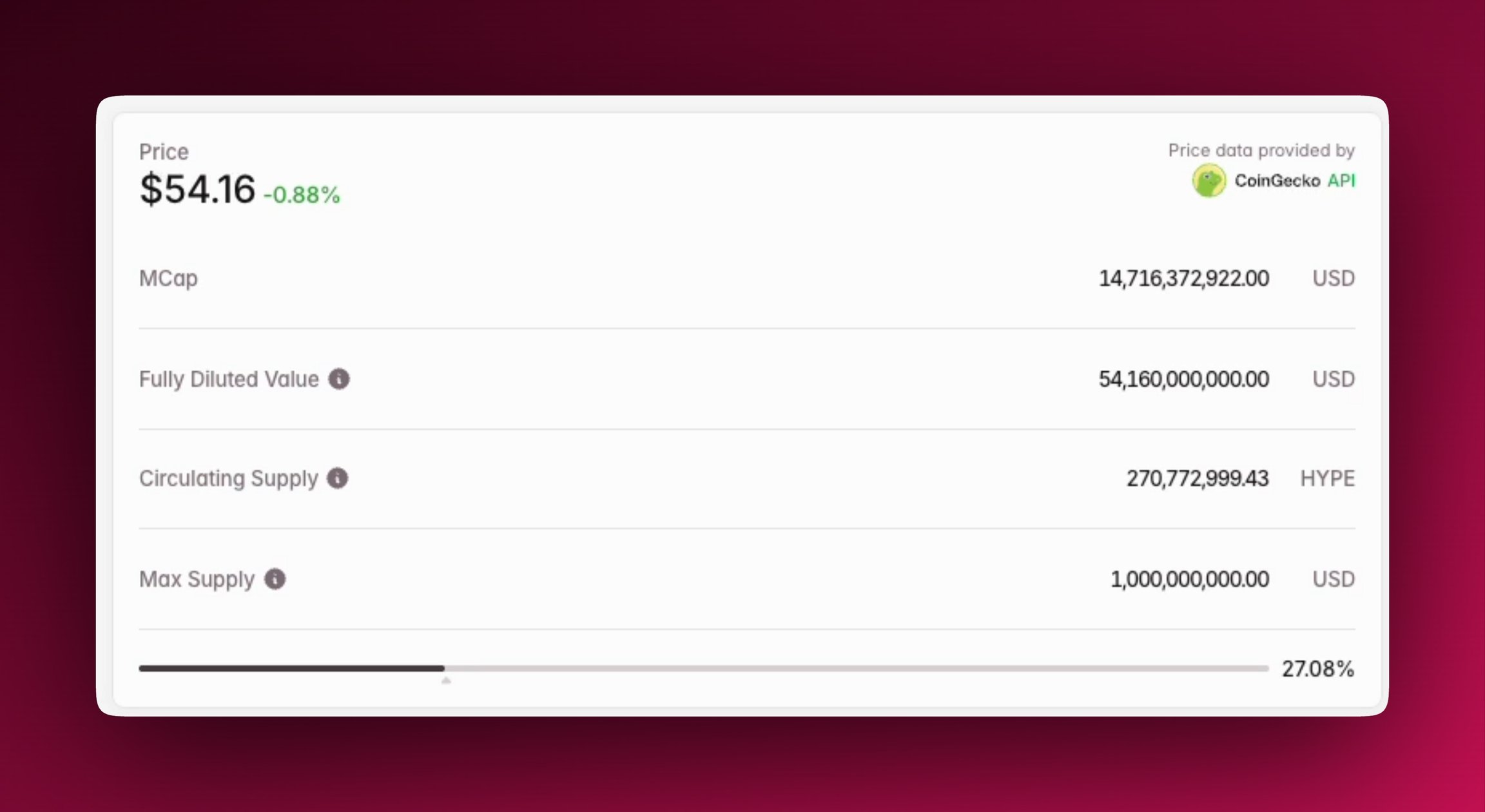
This panel gives a quick overview of a specific crypto token, showing its basic identity, market status, and key tokenomics signals at a glance.Fundamentals
This table summarizes the core market valuation and supply fundamentals of a crypto token that helps you understand how the token is valued today vs its potential value when all tokens are released.Using Fundamentals
- View by: USD / Token Amount
Released progress
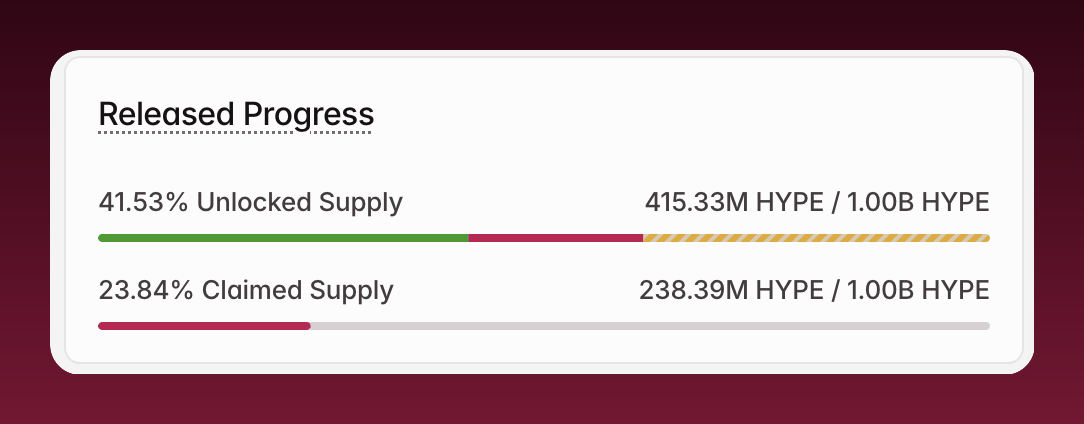
This panel presents how much of a token’s total supply has already been released into circulation and how much remains locked, which helps you understand token maturity and future dilution risk. Hovering your mouse over the element will show released, unreleased, TBD locked, and untracked token amount and percentage of total supply.
For tokens with unlock lifecycle tracking (currently Hyperliquid), the Released Progress panel includes additional rows:
Upcoming unlocks
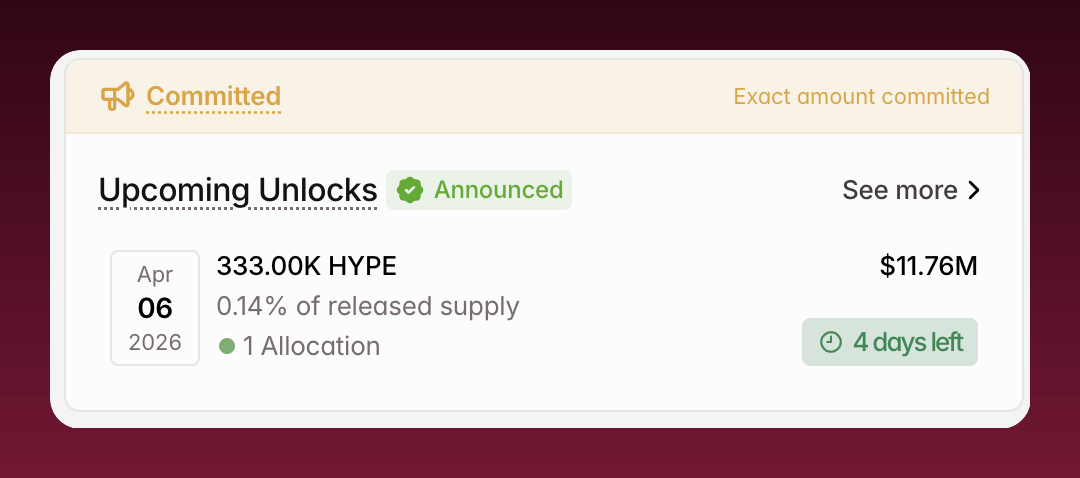
This panel highlights the next major token unlock event for the project. It provides understanding on how much new supply will enter the market, when it will happen, and how large the impact could be. Hovering your mouse over the element will show type of unlock, allocations, unlocked amount in token, USD, and percentage of released supply of that upcoming unlock event. For tokens with unlock lifecycle tracking (currently Hyperliquid), upcoming unlocks display a status badge:
When a Committed event is completed, the widget automatically rotates to show the next upcoming Whitepaper unlock.
Emission
This panel focuses on how many tokens have been emitted, or released into circulation, and where those tokens came from. This helps you understand the source of supply growth and token distribution dynamics. On type of unlock, hovering your mouse over the element will show type of unlock, allocations, and unlocked amount in token, USD, and percentage of released supply. Beside that is the emission component, which standardizes all supply changes into:- Inflation: all positive supply emission from cliff unlocks and linear releases.
- Deflation: all negative supply decreases from mechanisms such as burn.
- Emission: the difference between inflation and deflation in the timeframe.
Using Emission
- View by: All / +1D / +7D / +1M / +6M / +1Y / +4Y
- Break down by:
- Group allocation
- Type of unlock:
- Cliff unlock: an unlock event that occurs at a set interval greater than one day (e.g., weekly, monthly, quarterly). This represents a discrete, periodic release of tokens.
- Linear release: a continuous, daily release of a specific number of tokens. This represents a smooth, predictable increase in the circulating supply.
Allocations
This table exhibits how the total token supply is allocated across different purposes and groups, offering understanding about who controls the tokens and how future supply will be distributed. Clicking on the element will show precision and assumption of an allocation.Using Allocations
- Toggle: Group allocations
Unlock Progress & Events
The unlock widget shows total supply status, i.e., how much of the token’s supply is Released, TBD Locked, Unreleased, or Untracked. To the right of that, the Notable Cliff Unlocks shows 1 upcoming cliff unlock events (or All Historical & 2-year Future Unlock Events with Pro in unlock event). These components can be used to gauge the current status of token release progress and any important upcoming release events at a glance.Release Schedule
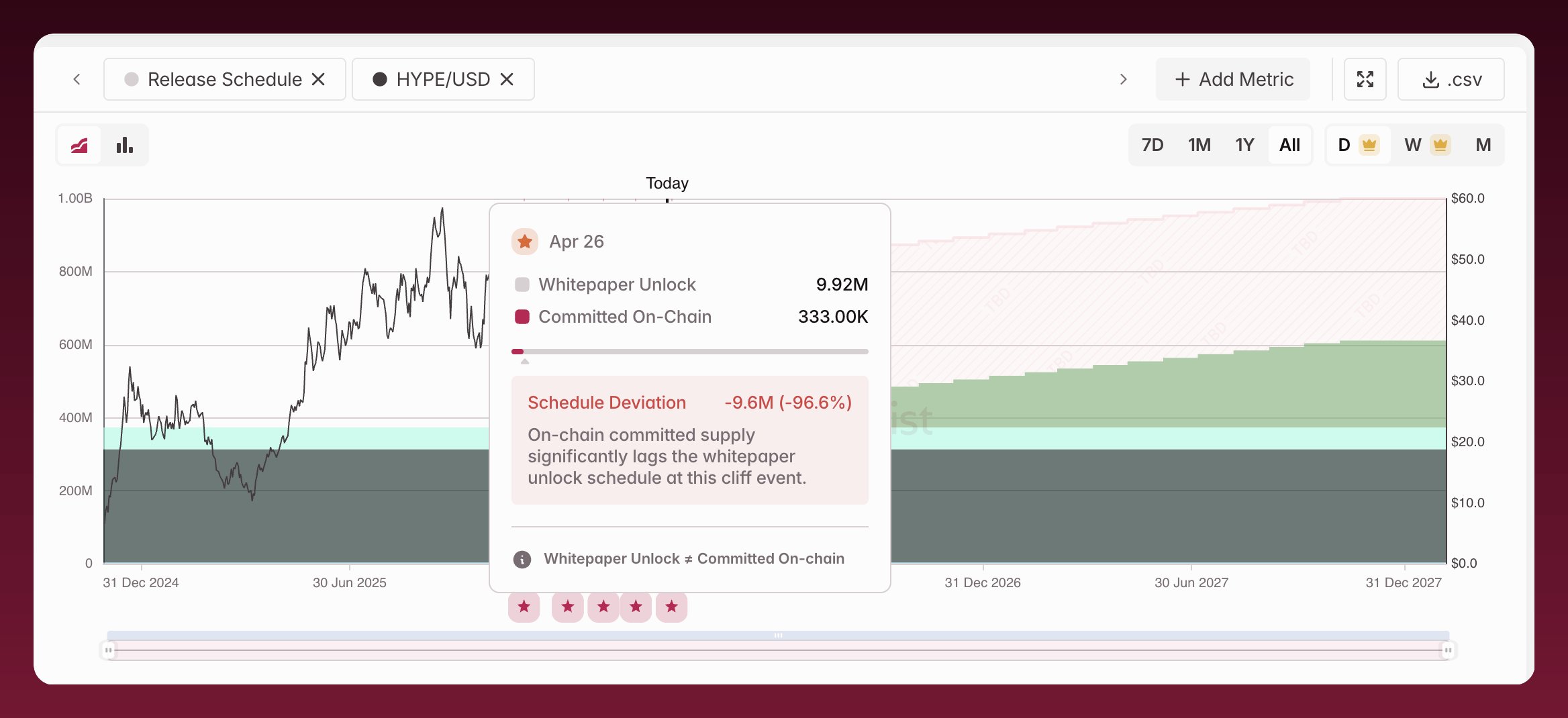
The Release Schedule shows how supply enters circulation over time, with interactive tools to customize the view. On the left, allocations can be toggled individually or regrouped into standard allocations for cross-project comparison. Both the chart and the allocation table update instantly, and Pro users can export the full dataset as CSV . The chart offers multiple controls:- Modes: Cumulative stacked (default) or a non-cumulative bar chart
- Timeframes: the last 7D, 1M, 1Y, or All for the entire historical and projected view
- Resolution: Monthly, Weekly , Daily
Unlock lifecycle markers
For tokens with unlock lifecycle tracking (currently Hyperliquid), the Release Schedule chart displays marker icons on the timeline at dates where:- An unlock event is scheduled (from the whitepaper release schedule)
- The project team has committed to a claim (announced via Discord)
Using Release Schedule
- Add metric:
- Release schedule
- Token / USD
- Token / Token
- Claim : the net amount claimers received from vesting addresses
- Total release supply : the total amount of a token that is unlocked and readily claimable into circulation at any time.
- Cumulative burn : the cumulative total of all tokens that have been permanently removed (burned) from circulation since launch.
- Burn : the amount of tokens removed from circulation during the specific period through burning mechanisms.
- View by: 7D / 1M / 1Y / All
- View by: D / W / M
View data source
This table gives detailed, verifiable information about each token allocation and how those tokens are released over time. It can help you understand supply mechanics, lockups, and future inflation risk.
Our Precision & Assumption framework helps you quickly judge how reliable each piece of tokenomics data is.
Assumptions show where the release data originates. Precision indicates how exact the timing is. This framework ensures that you aren’t just seeing what is set to unlock, but also how much confidence you should have in that information.
Learn more at Precision and Assumption.
Why It Matters
The Token Page combines every aspect of supply analysis into one standardized view. This makes it easier to evaluate dilution risk, investor incentives, and long-term sustainability, all in one place.FAQs
Where to next
- Explore more about our token page features: tokenomics, unlock events, competitor analysis, claimed, fundraising, buyback, burn, and updates.
- Visit BTC’s Overview.