> ## Documentation Index
> Fetch the complete documentation index at: https://docs.tokenomist.ai/llms.txt
> Use this file to discover all available pages before exploring further.
# Precision and Assumption
# Overview
## The Problem: Unlock Data Lacks Consistency
Crypto projects report release schedules without any standardized enforcement. Data can be spread across blog posts, whitepapers, on-chain contracts, and multisigs, leading to ambiguity and making it difficult for users to trust the information they find.
## Our Solution: Precision & Assumption
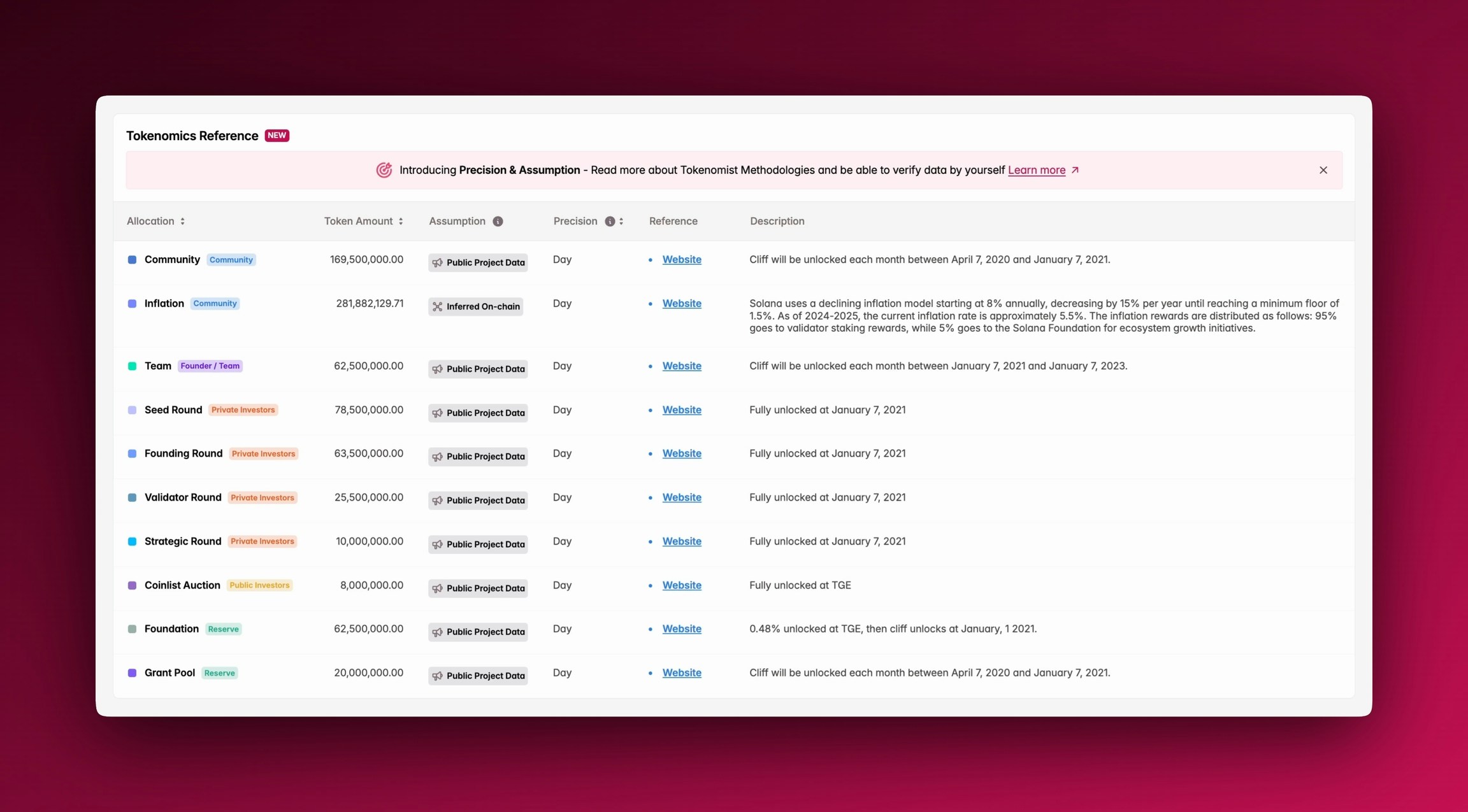
We introduce the **Precision & Assumption** framework. For every token we track, we show you **where** our data comes from (*Assumption*) and **how accurate** its timing is (*Precision*). This framework gives you the clarity to assess the transparency of a release schedule.
 # Methodology
## Definitions
* **Assumption (Data Source Types):** Indicates where the release schedule data originates.
* **Precision (Release Time):** Indicates how precise the release timing is.
## Assumption (Data Sources)
| Source Type | Definition |
| ------------------------------------------- | --------------------------------------------------------------------------------------- |
| **Public Project Data & On-chain Verified** | The release schedule was publicly announced by the project and verified by us on-chain. |
| **Public Project Data** | The release schedule was publicly announced by the project (e.g., in a blog post). |
| **Vesting Contract** | The release schedule is derived directly from a time-lock smart contract. |
| **Private Project Data** | The release schedule was confirmed privately by the project's team. |
| **Inferred On-chain** | The release schedule is interpreted by our team from on-chain behavior. |
## Precision (Release Timing)
| Precision Level | Definition |
| -------------------- | ------------------------------------------------------------- |
| **Second** | The release occurs at the exact second specified. |
| **Block** | The release is tied to a specific block number. |
| **Hour** | The release can occur at any time within the specified hour. |
| **Day** | The release can occur at any time within the specified day. |
| **Week** | The release can occur at any time within the specified week. |
| **Month** | The release can occur at any time within the specified month. |
| **To Be Determined** | The release time is not yet known (see TBD Locked Supply). |
# Example Cases
## Example 1: Vesting Contract with Exact Timestamps
* **Scenario:** A vesting contract is deployed on-chain with parameters specifying exact unlock times down to the second (e.g., `2025-01-01 00:00:00 UTC`).
* **Analysis:** Because the contract itself dictates the precise timing, the data source is both transparent and verifiable on-chain. Users can independently confirm the schedule without ambiguity.
* **Our Categorization:** `Vesting Contract` with precision **Second** (the unlock will execute exactly at or very close to that timestamp).
## Example 2: Whitepaper with Monthly Unlocks
* **Scenario:** A whitepaper states that 10% of tokens unlock "monthly" (e.g., January, February, March) without specifying days or hours.
* **Analysis:** The data is official, but without finer time granularity. The unlock could occur on the 1st, 15th, or 30th of the month.
* **Our Categorization:** `Public Project Data` with precision **Month** (the unlock can occur at any point during the specified month).
## Example 3: Private Confirmation from Project
* **Scenario:** The team privately shares aspects of their vesting schedule with Tokenomist but does not publish it publicly.
* **Analysis:** While the source is direct, it lacks public verifiability. Confidence depends on the team’s reliability rather than on-chain guarantees.
* **Our Categorization:** `Private Project Data` with precision **Day** (if the team specifies exact dates, but not timestamps).
# Access Features
The Precision & Assumption framework is used across the following Tokenomist features:
* [**Overview Pane**](/overview-pane) — Every token page includes a Tokenomics Reference section that displays the Assumption and Precision tags for each allocation.
# Using Precision & Assumption
**1. Evaluate Reliability of Unlocks**
* A **Cliff Unlock** for an *Investor* allocation with a `Vesting Contract` + `Second` precision is highly reliable, near-certain.
* An unlock with `Inferred On-chain` + `Month` precision is far less reliable and should be treated cautiously.
**2. Compare Allocations Across Sources**
See how different allocations within a project vary in reliability — some may be contract-verified while others are only privately confirmed.
**3. Incorporate into Risk Assessment**
Before acting on vesting data, always check its **Assumption** and **Precision** to gauge confidence.
# Methodology
## Definitions
* **Assumption (Data Source Types):** Indicates where the release schedule data originates.
* **Precision (Release Time):** Indicates how precise the release timing is.
## Assumption (Data Sources)
| Source Type | Definition |
| ------------------------------------------- | --------------------------------------------------------------------------------------- |
| **Public Project Data & On-chain Verified** | The release schedule was publicly announced by the project and verified by us on-chain. |
| **Public Project Data** | The release schedule was publicly announced by the project (e.g., in a blog post). |
| **Vesting Contract** | The release schedule is derived directly from a time-lock smart contract. |
| **Private Project Data** | The release schedule was confirmed privately by the project's team. |
| **Inferred On-chain** | The release schedule is interpreted by our team from on-chain behavior. |
## Precision (Release Timing)
| Precision Level | Definition |
| -------------------- | ------------------------------------------------------------- |
| **Second** | The release occurs at the exact second specified. |
| **Block** | The release is tied to a specific block number. |
| **Hour** | The release can occur at any time within the specified hour. |
| **Day** | The release can occur at any time within the specified day. |
| **Week** | The release can occur at any time within the specified week. |
| **Month** | The release can occur at any time within the specified month. |
| **To Be Determined** | The release time is not yet known (see TBD Locked Supply). |
# Example Cases
## Example 1: Vesting Contract with Exact Timestamps
* **Scenario:** A vesting contract is deployed on-chain with parameters specifying exact unlock times down to the second (e.g., `2025-01-01 00:00:00 UTC`).
* **Analysis:** Because the contract itself dictates the precise timing, the data source is both transparent and verifiable on-chain. Users can independently confirm the schedule without ambiguity.
* **Our Categorization:** `Vesting Contract` with precision **Second** (the unlock will execute exactly at or very close to that timestamp).
## Example 2: Whitepaper with Monthly Unlocks
* **Scenario:** A whitepaper states that 10% of tokens unlock "monthly" (e.g., January, February, March) without specifying days or hours.
* **Analysis:** The data is official, but without finer time granularity. The unlock could occur on the 1st, 15th, or 30th of the month.
* **Our Categorization:** `Public Project Data` with precision **Month** (the unlock can occur at any point during the specified month).
## Example 3: Private Confirmation from Project
* **Scenario:** The team privately shares aspects of their vesting schedule with Tokenomist but does not publish it publicly.
* **Analysis:** While the source is direct, it lacks public verifiability. Confidence depends on the team’s reliability rather than on-chain guarantees.
* **Our Categorization:** `Private Project Data` with precision **Day** (if the team specifies exact dates, but not timestamps).
# Access Features
The Precision & Assumption framework is used across the following Tokenomist features:
* [**Overview Pane**](/overview-pane) — Every token page includes a Tokenomics Reference section that displays the Assumption and Precision tags for each allocation.
# Using Precision & Assumption
**1. Evaluate Reliability of Unlocks**
* A **Cliff Unlock** for an *Investor* allocation with a `Vesting Contract` + `Second` precision is highly reliable, near-certain.
* An unlock with `Inferred On-chain` + `Month` precision is far less reliable and should be treated cautiously.
**2. Compare Allocations Across Sources**
See how different allocations within a project vary in reliability — some may be contract-verified while others are only privately confirmed.
**3. Incorporate into Risk Assessment**
Before acting on vesting data, always check its **Assumption** and **Precision** to gauge confidence.